
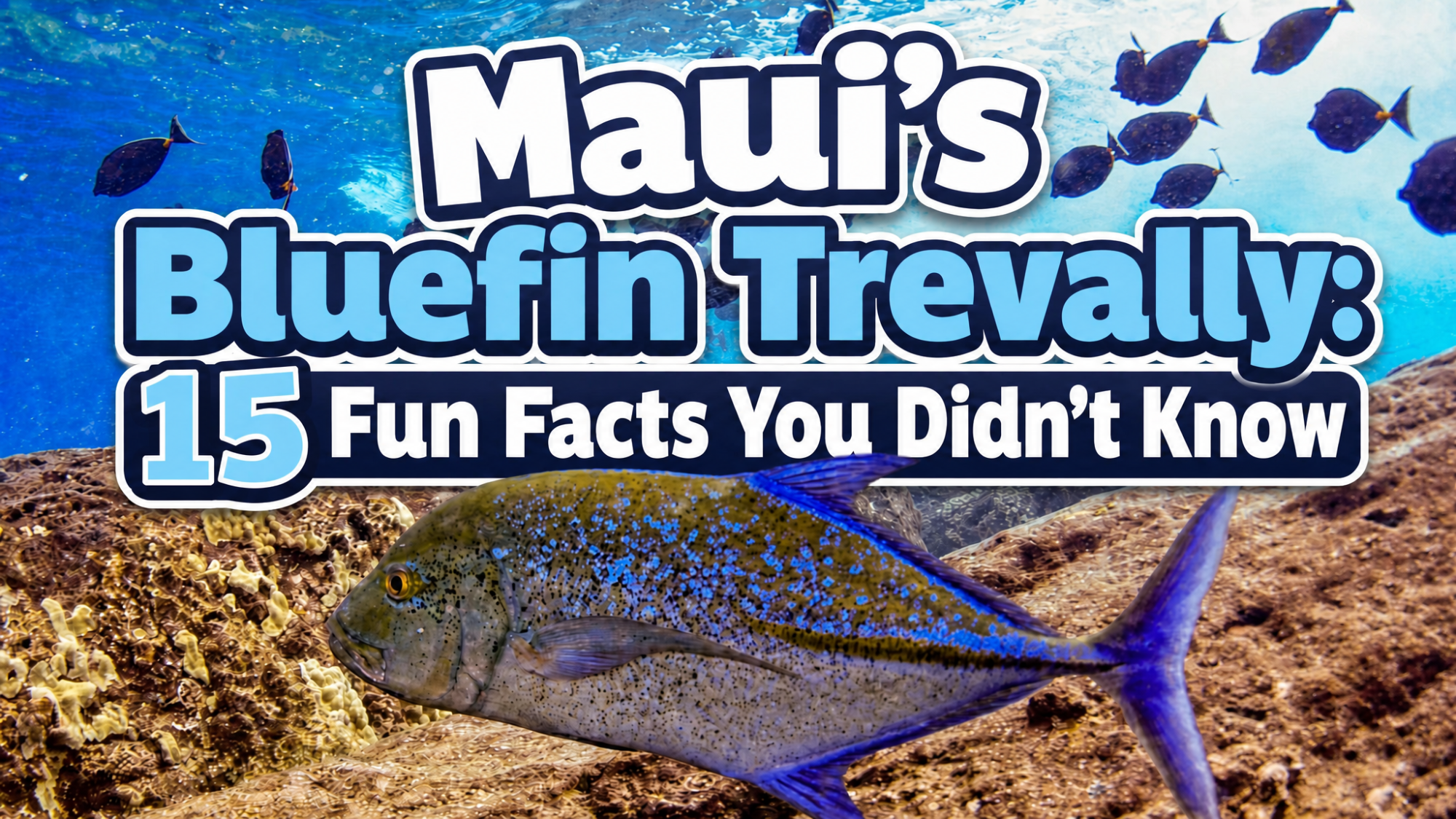
Maui’s Bluefin Trevally: 15 Fun Facts You Didn’t Know
TL;DR: Maui’s Bluefin Trevally in 5 Key Points
-
- Maui-Specific Behavior: These fish show unique hunting, schooling, and coloring shaped by Maui’s warm reefs—especially around Molokini Crater and Turtle Town.
-
- Special Adaptations: They have movable “zoom” lenses and can burst up to 40 mph for rapid ambushes, plus vibrant electric-blue fins that shift with light and depth.
- Hybridization Effects: Crossbreeding in Hawaiian waters causes noticeable variations in size, color, and behavior, making Maui trevally distinct from other regions.
- Responsible Ecotourism: Guided tours that respect distance and movement help protect trevally behavior and reef health while offering excellent viewing opportunities.
- Best Viewing Tips: To fully enjoy sightings, stay calm, avoid chasing, keep a respectful distance (6–10 feet), and follow experienced guides for safe, sustainable encounters.
Maui’s bluefin trevally are shaped by the islands’ warm, nutrient-rich reefs, with reliable sightings on Molokini Crater and Turtle Town tours that reflect Maui-specific behaviors. In our Maui Snorkel Tours, these fish reveal how hybridization in the Main Hawaiian Islands and local prey dynamics drive color, size, and schooling patterns you won’t see in other waters. This post lays out 15 bite-sized facts—covering biology, ecology, and practical observation tips—grounded in Molokini Crater ecotourism practices that protect wildlife.
Ready for a deeper Maui snorkeling experience? Use promo code LUCKYME for 10% off your next Makena Coast Charters adventure.
1. Biological Zoom Lenses
Maui’s bluefin trevally hide a highly specialized, movable lens inside each eye that functions like a pocket-size zoom. This mechanism lets them shift focus between distant targets and nearby prey without turning their heads, keeping their bodies compact while they scan the reef.
In real-world snorkeling around Molokini Crater, that capability shows up as rapid shifts in attention from a distant schooling fish to a closer target, while the fish continue their steady drift along the reef edge. Guides on Makena Coast Charters note how a single trevally can lock onto a far-off bait ball and pivot to a nearby damselfish in the blink of an eye, with minimal body movement.
Practical implication for snorkelers: let the fish do the focusing. If you chase or snap photos aggressively, you’ll miss the moment when the zoom lens activates. Keep your movements slow and predictable, stay closer to the guide’s footprints, and shoot from a stable position to capture the lens shift without scaring the fish.
2. Extreme Cheetah-Like Acceleration
Extreme speed defines Maui’s bluefin trevally more than any other trait. In Maui’s warm reefs, these fish can go from zero to about 40 mph in under a second, a burst that lets them ambush prey with precision. This velocity comes from Maui’s currents and prey pulses near Molokini Crater, where fast starts are common. In Maui Snorkel Tours, you’ll witness these splits-second moves along ledges and over flats Molokini Crater.
Practical effect for snorkelers: you won’t outrun a sprinting trevally, so safety and space come first. Stay with the guide, resist chasing, and keep your distance when bursts occur. Our Makena Coast Charters crews time vantage points around Molokini Crater and Turtle Town to maximize sightings while preserving wildlife—the Molokini ecotourism effect in action. Note that hybridization in the Main Hawaiian Islands can shift coloration and behavior, so encounters carry a local signature rather than a universal rule.
3. Bioluminescent-Like Neon Fins
Bioluminescent-Like Neon Fins are a signature feature of Maui bluefin trevally. The electric-blue dorsal, anal, and tail fins shimmer as light catches the reflective scales, a visual cue you’ll remember long after the snorkel. This brilliance comes from structural reflection, not true bioluminescence, and it depends on water clarity and sun angle.
The color patterns shift with depth and light; near Molokini Crater the fins often flash brighter as sun angles skim the reef. Because the effect comes from how light bounces off the scales, visibility can swing within a few meters. On our Molokini Crater and Turtle Town snorkel tours, you’ll notice these changes as trevally glide along ledges and overhangs.
- Lighting and depth govern how the electric-blue fins read on camera; at shallow reef edges they pop most when the sun is high and light hits from the side.
- Photography tips: use a fast shutter (1/1000s or faster), keep a modest ISO, and focus on the trailing edge of the fins to maximize contrast against the darker reef.
- Observation tip: study schooling patterns; the flicker of fins often coincides with fish turning to intercept prey, so be patient and avoid chasing.
4. Radical Color-Shifting Ambush Mode
Radical color-shifting ambush mode is the signature tactic of Maui’s bluefin trevally, used in reef shadows around Molokini Crater and Turtle Town. These fish can switch from bright brassy tones to near black in an instant, making them vanish before prey realizes danger. The effect is as much about observation as biology: color shifts cue a momentary pause in observers while the trevally closes the gap. Lighting, depth, and schooling size drive the shift, and on clear Maui days you’ll notice the contrast as a living cue for where ambush will occur at Molokini Crater.
Practical insight: when you spot a near-black silhouette in a shaded crevice, resist chasing. Slow your movements, let the fish reset, and rely on your Makena Coast Charters guide to read the ambush window. Color cues are brief and highly context-dependent; your best chance comes on guided snorkel tours where a naturalist reads the reef for you.
5. Tactical Nuclear Foraging Partnerships
In Maui, Tactical Nuclear Foraging Partnerships appear as coordinated feeding by trevally that turns reef ledges into hunting lanes. They form shifting arcs along Molokini Crater and around Turtle Town, with individuals rotating attack roles to herd prey toward crevices. This isn’t just a flash in the pan—Maui’s Main Hawaiian Islands show color and size variation from hybridization, which can influence how these foraging displays look from a snorkel boat. The Molokini Crater ecotourism model, with disciplined viewing and regulated boat traffic, helps these dynamics unfold more reliably for guided snorkel groups.
Observation hinges on conditions: steady currents, clear water, and minimal disturbance. When seas cooperate, you’ll see synchronized lunges where multiple fish surge in a single pass, then peel off in a ripple that makes the same sequence visible to guests on Turtle Town and Molokini itineraries.
6. Hybridization in the Main Hawaiian Islands
Hybridization among trevally species in the Main Hawaiian Islands isn’t rare, and Maui is a focal point for observing its practical effects on color, size, and behavior. In and around Molokini Crater and Turtle Town, researchers and local guides have noted individuals that don’t fit a single lineage, suggesting ongoing gene flow between species. This matters for Maui snorkel tours because it translates into more color variation and sometimes atypical body shapes guests can see on our guided trips.
From a management lens, hybrid zones complicate species IDs and fisheries planning. If color or size shifts blur the boundaries between trevally lineages, you can’t rely on a single-name ID in field notes or wildlife sightings. That means ecotourism operators must emphasize non-invasive observation and avoid assuming pure lineages when guiding guests; it also informs local biodiversity discussions and how we frame sightings on Molokini Crater tours.
Molokini Crater ecotourism demands steady, respectful viewing; hybridization can increase conspicuous variation which, if handled poorly by crowds, can stress fish. Our guides focus on distance, group spacing, and no chasing to preserve behavior while still offering vibrant, telltale color cues that hint at hybridization.
7. Maui Waters Shape Their Diet Near Molokini
In Maui, bluefin trevally diets are shaped by prey pockets formed around Molokini Crater. The main prey base—small reef fish such as wrasse and chromis, plus crustaceans and shrimp—pulses with currents and upwelling unique to this region. That Maui-specific prey dynamic makes hunting windows more predictable on Molokini Crater and Turtle Town tours than on other reefs. Molokini Crater ecotourism relies on responsible viewing to keep reef health intact. Hybridization across the Main Hawaiian Islands adds color and size variation you may notice in Maui, influencing how trevally color up and behave in these waters.
- Prey items: small reef fish (wrasse, chromis), shrimps, and other crustaceans observed around Molokini.
- Timing cues: prey pulses peak with mid-channel currents; higher prey density correlates with trevally activity.
- Observation cues for families: look for sudden darting near coral walls and quick bursts that break the silhouette of the reef.
- Trade-offs for viewing: chasing fish disrupts feeding arenas; patient guides maximize natural behavior, sometimes with brief pauses for photos.
The underlying reality is that prey dynamics drive movement more than random wandering. If you expect long, slow glides, you’ll miss bursts; patient observation yields the most compelling moments when guided by trained captains.
8. Molokini Crater Ecotourism Effect
Maui’s Molokini Crater ecotourism isn’t an afterthought; it directly shapes how bluefin trevally behave and how guests experience them. Steady visitor activity and guided snorkeling etiquette influence reef health and fish schooling in ways you can feel on a tour day. Hybridization among trevally populations in the Main Hawaiian Islands adds color and size variation you may notice on a given day, complicating a simple species sketch but enriching the sighting experience around Molokini and Turtle Town.
Best viewing practices are non-negotiable. Keep a respectful distance, move slowly, and let the guides manage group pacing. Chasing, crowding a school, or banging fins disrupts feeding and makes trevally more elusive on subsequent dives.
- Maintain a comfortable distance from trevally (6–10 feet) to reduce stress and prevent bait-pinning as schools move.
- Avoid sudden movements or chasing; observe from the side rather than cutting through the school’s path.
- Keep fins quiet and mind your buoyancy to minimize reef disturbance.
- Respect coral and other wildlife; never touch, chase, or block access to turtles or reefs.
Complete physical, biological, and performance specifications for Maui’s bluefin trevally are provided below for quick reference during planning and on-tour notes.
- Physical: typical length range around Maui is 12–24 inches (30–60 cm); robust, laterally compressed body with a broad caudal fin for quick bursts.
- Biological: coloration includes brassy-silver bodies with iridescent blue and black spotting; dorsal, anal, and tail fins can display electric-blue tints in adults; color can vary with light and schooling.
- Performance: bursts up to 0–40 mph in under a second; highly maneuverable in complex reef structures; reaction times are very fast to new cues.
- Ecological note: prey includes small reef fishes and crustaceans; common habitats around Molokini Crater and Turtle Town.
- Conservation note: subject to Hawaii’s general reef wildlife regulations; observe, don’t interact, and avoid disturbing the fish or coral.
9. Seasonal Movements Around Maui
Seasonal movements around Maui drive Bluefin Trevally to shift between favored haunts as currents and prey change. On Molokini Crater and Turtle Town snorkel tours, you’ll see distinct schooling patterns by month and sea state. Maui-specific behavior means the same species can look very different here than in other Hawaiian spots.
From late spring to summer, trevally often mass along Molokini’s outer slopes where upwelling feeds pelagic prey. In winter, stronger currents and cooler water push activity closer to Turtle Town’s shallower reefs, with calmer conditions that still reward patient observers. If you’re shopping Maui Snorkel Tours, choose itineraries that mix both sites. Molokini Crater ecotourism practices also shape how wildlife is viewed and protected.
10. Social Structure and Schooling Patterns in Maui
In Maui, bluefin trevally schooling is a dynamic, reef-wide pattern driven by currents and prey pulses. Group sizes vary from small pods of about 5–12 individuals to larger assemblies of 20–30 near notable reef structures around Molokini Crater and Turtle Town. When bait concentrations surge, the school tightens into a compact arc; when prey disperses, the group loosens and drifts with the current. For snorkelers, this means sightings arrive in bursts rather than a steady, single-pass performance.
- Be patient during prey-driven bursts and let the school reveal itself rather than chasing it.
- Move with the current, not against it; slow, deliberate motions reduce disturbance and improve observation windows.
- Keep a respectful distance to avoid altering the school’s behavior or stressing individuals.
Hybridization in the Main Hawaiian Islands adds color and size variation within Maui populations, which influences how observers perceive individuals within a school. Color nuances or subtle body shape shifts aren’t just cosmetic; they reflect local genetics and microhabitat differences that can affect how schools look from day to day.
11. Color Variation Across Maui Reefs
Color variation isn’t random in Maui’s bluefin trevally. Maui’s warm, clear water, reef health, and sun angle shape color cues that differ from other parts of Hawaii. On Molokini Crater and Turtle Town snorkel tours, you often see fins blaze electric blue against a brassy-silver body when the light is right, then fade to subtler tones as you drift into shade.
Hybridization in the Main Hawaiian Islands adds another layer. Local color ranges can include intermediate patterns, so two individuals side by side may display different fin edges or spot density. That variation is not a defect; it’s a signal of mixed ancestry that shows up most clearly in Maui’s trevally populations.
- Key factor: Light and depth shape color. Color shifts with depth and light angle; deeper or shaded spots render fins in cooler blues or purples, while sunlit zones exaggerate brighter blues and iridescent spots.
- Maui-specific coloration: In Maui, midwater schooling can enhance fin blue tones, with body patterns showing brassy-silver speckles and dark fin margins that differ from other regions due to local prey and mixed ancestry.
- Photo tips for capturing color: Shoot with natural light when possible, avoid aggressive flash, shoot RAW, and set white balance to daylight; backlight from the surface can help bring out fin color without washing it out.
- Observation tips for Molokini vs Turtle Town: Molokini’s clear, filtered light makes blue fins pop; Turtle Town’s shallower reefs offer higher contrast in body color and spots; plan shots and remain patient to catch color shifts.
12. Adaptations for Reef Navigation
Bluefin trevally navigate reef mazes with a compact, maneuverable body and a fin setup that favors rapid pivots. They tuck their pectoral fins and push with a powerful tail, threading along rock faces and coral ledges where space is tight. In Maui, this mobility shows up clearly around Molokini Crater and Turtle Town, where currents funnel fish into narrow gaps and observers must time drift cues to see them.
Practical implication for snorkelers: avoid crowding and chasing. The agility that lets them turn on a dime also increases the risk of contact with fins or gear, so guides pace groups and choose viewing corridors where trevally are likely to pass. Expect them to hug shelves and slip through crevices for best glimpses.
13. Predator Evasion and Defensive Tactics
Predator evasion is a defining trait of Maui’s bluefin trevally. In the reefs around Molokini Crater and Turtle Town, these fish survive by explosive starts, abrupt changes in direction, and tight use of rock ledges to break line of sight from pursuing predators. Maui’s warm, nutrient-rich waters and local prey patterns shape these tactics, making their evasive moves distinct from similar species elsewhere. Observe these patterns on Molokini Crater tours and Turtle Town snorkel trips with Makena Coast Charters: Molokini Crater is a reliable backdrop for seeing how reef geometry influences speed and visibility. Molokini Crater
Common escapes include abrupt s-curves, rapid dives into crevices, and sudden bursts toward open water. These moves confuse predators and create brief openings for observers when the fish re-emerge near ledges. On our Molokini Crater and Turtle Town trips, a trevally often executes a tight S-turn around a coral head, then appears again a few meters away to feed on a drifting school—clear evidence that reef geometry drives their timing.
From a safety and viewing standpoint, these tactics mean you won’t get a patient, slow approach. Stay with the guide, keep a relaxed posture, and avoid chasing or blocking their line of retreat. Guides anticipate bursts and position guests to maintain a safe buffer while maximizing sightings, and Molokini Crater ecotourism practices emphasize minimizing disturbance to keep these evasions natural.
14. Reproductive Strategies in Hawaiian Waters
Maui’s bluefin trevally reproduce with strong site fidelity to Molokini Crater and nearby reefs. Spawning cues align with warmer water pulses and lunar cycles, driving aggregations along reef edges where currents concentrate eggs and larvae. Ecotourism here works best when tours respect breeding sites and keep a safe distance, reducing disturbance during sensitive periods.
Breeding is externally fertilized in loose groups; eggs drift with currents. Spawning sites are known to guides, and mating signals accompany courtship. Seasonal warming and local currents can tighten or loosen schools, changing visibility from day to day. Hybridization in the Main Hawaiian Islands can introduce color signals used in mating rituals that you may notice during Maui observations.
Complete physical, biological, and performance specifications
- Physical: Maui-typical length range; robust, laterally compressed body; distinctive blue and black spotting on brassy-silver flanks.
- Biological: external fertilization in reef-edge spawning aggregations; spawning cues tied to warmer water pulses and lunar cycles; strong site fidelity to Molokini and nearby reefs; color variation linked to breeding status and hybridization.
- Performance: bursts of speed for ambush and rapid reef navigation; high maneuverability around ledges and corals; quick directional changes when pursuing schooling prey.
15. Maximum Size and Growth in Maui Waters
In Maui, bluefin trevally reach noticeably larger sizes than in many parts of their range. Typical adults run roughly 45–70 cm (18–28 inches) in length, with standout individuals approaching about 1 meter (roughly 3 feet) in sheltered Maui habitats such as the Molokini Crater outer reef.
Growth patterns here are shaped by prey abundance, habitat structure, water temperature, and age at maturity. The Molokini Crater ecosystem supports robust prey pools and complex ledges, while hybridization across the Main Hawaiian Islands adds genetic variation that can influence observed size ranges and body shape. Ecotourism practices at Molokini—when guided and low-impact—help maintain reef health and the food webs that support bigger fish, which in turn affects what you might see on snorkeling tours.
Size also informs behavior and visibility. Larger trevally tend to hold outer reef ledges with deliberate, powerful strokes, making them more conspicuous on guided snorkel excursions, while smaller individuals frequent shallower holes and are quicker to retreat when pressured.
Frequently Asked Questions
- Where in Maui are bluefin trevally most commonly observed during snorkeling tours?Molokini Crater and Turtle Town on Makena Coast Charters tours.
- Are bluefin trevally aggressive toward snorkelers or swimmers? They’re predatory by nature, but sightings stay peaceful if you stay calm, avoid chasing, and respect space.
- What makes Maui bluefin trevally behavior different from other places? Warmer reef systems and local prey patterns create distinct schooling and color shifts around Molokini and Turtle Town.
- What is Hybridization in the Main Hawaiian Islands and how does it relate to trevally?Interbreeding among trevally species can influence coloration, size, and behavior in Maui populations.
- When is the best time to observe bluefin trevally on Maui snorkeling tours? Sightings are reliable year-round on guided Molokini Crater and Turtle Town trips; visibility varies with tides and conditions.